
Every day, machines are doing something that once seemed exclusively human: noticing what matters. A radiologist’s eye catching a shadow on a lung scan, a quality inspector spotting a hairline crack on a circuit board, a fraud analyst flagging a payment that doesn’t quite fit. Pattern recognition is the computational equivalent of that instinct – systems trained to identify objects, signals, and anomalies across vast streams of data. This article traces how industries from healthcare to banking, and countries from Germany to South Korea, are deploying these systems at a scale no human team could match.
Every second, hospitals, factories, and financial institutions generate more visual and behavioral data than any team of analysts could reasonably review. The problem isn’t collecting the data. It’s making sense of it fast enough to matter.
Three distinct capabilities sit at the center of this challenge. Object recognition identifies what something is – a tumor on a scan, a crack in a circuit board. Signal classification sorts incoming data into known categories, the way a bank’s system flags a transaction type as routine or suspicious. Anomaly detection catches what doesn’t fit, even when no one defined the rule in advance.
Radiologists at institutions like Germany’s Charité hospital and Massachusetts General in Boston rely on imaging software to surface findings that warrant a second look. South Korean manufacturers like Samsung use visual inspection systems to catch production defects at speeds no human inspector could match. Singapore’s financial regulators depend on transaction monitoring to catch irregularities across millions of daily transfers. Human review alone simply can’t keep pace.
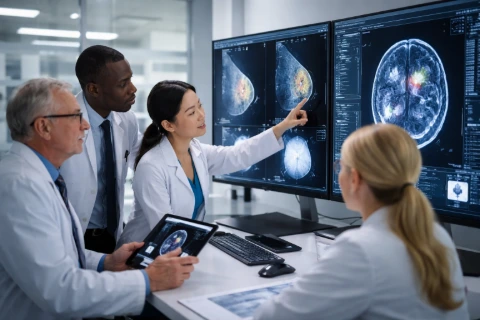
Radiologists in the Netherlands and Canada now work alongside AI imaging systems that flag suspicious masses in mammograms or anomalies in MRI scans before a clinician reviews them. These tools don’t replace the doctor’s judgment – they direct attention, reducing the chance that a subtle early-stage tumor goes unnoticed during a busy shift. In India, where specialist shortages are acute, similar systems help extend diagnostic reach into regions with limited radiology staff.
Factories apply the same visual logic differently. German automotive plants use high-speed cameras to catch surface defects on body panels that human inspectors would miss at production line speeds. Electronics manufacturers in China and Mexico run comparable systems to identify soldering errors or missing components on circuit boards before a faulty unit ships.
Biometrics and autonomous vehicles round out this image-dependent group. Airports from Singapore to Dubai use iris and facial recognition for border verification. Self-driving systems, meanwhile, must parse roads, cyclists, pedestrians, and traffic signs simultaneously – often in rain, glare, or heavy traffic – where a misread pattern has immediate physical consequences.
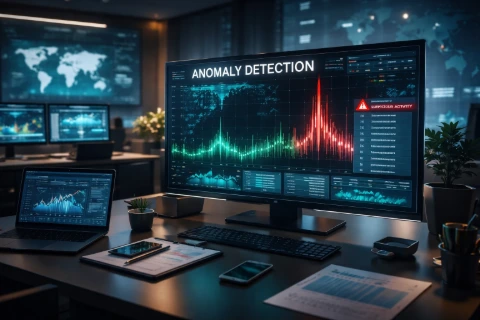
Fraud rarely announces itself. Banks and payment platforms catch it by comparing each transaction against a user’s established behavior – and flagging whatever breaks the pattern. Safaricom’s M-Pesa network in Kenya processes millions of mobile payments daily, using anomaly detection to identify account takeovers within seconds of unusual activity. In Brazil, digital banks like Nubank apply similar logic to detect money-laundering signals, where clusters of small transfers mimic known layering techniques. Visa’s card network in the US screens roughly 500 transactions per second, running each against models trained on coordinated fraud patterns.
Document processing follows the same principle. Governments in Australia and the UAE now route scanned identity documents, tax forms, and permit applications through OCR and classification systems that read, sort, and forward paperwork automatically. French logistics operators apply image recognition to shipping manifests and customs records, cutting processing times from days to hours.
The practical payoff is straightforward: fewer manual errors, faster throughput, and human reviewers spending their time on the cases that genuinely need judgment.
Across medicine, manufacturing, finance, mobility, and public administration, the ability to identify recurring signals and surface anomalies has moved from specialist tool to operational foundation. Radiologists in South Korea rely on AI-assisted imaging to flag suspicious tissue before a clinician reviews the scan. Assembly lines in German automotive plants catch surface defects in milliseconds. Banks in Brazil flag irregular transaction sequences before fraud completes. None of this works through human attention alone at the required scale. Machines handling these detection tasks free professionals to apply judgment where it genuinely matters – the ambiguous case, the ethical call, the decision with consequences. Speed, safety, accuracy, and scale are the practical gains, but the deeper shift is structural: pattern recognition has become the layer through which industries process reality before humans engage with it.