
Computational systems have long been capable of identifying structure in data – finding regularities, classifying inputs, and flagging anomalies at speeds no human analyst could match. What changed over decades of research was not the basic ambition but the methods used to achieve it. Early recognition depended on manually engineered rules. Machine learning reduced that dependency. Deep learning expanded what was recognizable. Each transition extended the reach of automation, though not without introducing new constraints. The gains in capability are real; so are the limits on full autonomy.
Decades before neural networks became a standard reference point, engineers built recognition systems by hand. Character recognition software from the 1970s and 1980s, for instance, relied on explicit rules: a letter “A” had two diagonal strokes meeting at a peak with a horizontal crossbar. Developers specified these geometric conditions directly, translating domain knowledge into threshold-based logic. The approach worked reasonably well under controlled conditions – clean fonts, consistent lighting, standardized inputs.
Variation exposed the brittleness immediately. Handwritten characters, degraded signals, or slightly rotated images could break a system that no one had anticipated. Each new source of noise required additional rules, and the maintenance burden grew faster than the coverage.
Statistical machine learning shifted the underlying method. Rather than describing patterns in advance, models inferred relationships from labeled examples – learning which pixel configurations consistently corresponded to which outputs. Adaptability improved because the system derived its own decision boundaries from data, not from a developer’s prior assumptions about what mattered.
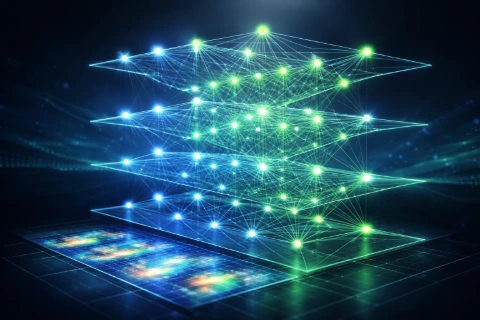
Layered computational models changed what recognition systems could realistically achieve. Where earlier approaches required engineers to manually specify which features a system should examine, neural networks learned those representations directly from training data. Each layer of a network extracted progressively more abstract information, turning raw pixel values or audio waveforms into structured internal representations without explicit human guidance.
Image and speech recognition improved sharply once this architecture became practical. A convolutional neural network trained on millions of labeled photographs could identify edges, textures, and shapes autonomously, outperforming hand-engineered pipelines by significant margins. By 2012, deep learning models had reduced image classification error rates on benchmark datasets by nearly half compared to prior methods.
Scaling these models demanded substantial computing resources. Parallel processing across GPU clusters cut training times from weeks to days, making rapid experimentation feasible. Larger datasets compounded the gains. Systems trained on broader, more varied data generalized better across conditions, extending viable recognition tasks well beyond controlled laboratory settings.

Accurate, low-latency recognition fundamentally changed what automated systems could do with a classified input. Rather than logging a result for later review, modern pipelines use recognition outputs to trigger immediate downstream actions – fraud detection systems flag and block transactions within milliseconds, autonomous vehicles adjust steering in response to detected obstacles, and medical imaging tools route flagged scans directly to specialists. Recognition shifted from a passive analytical step to an active component embedded within detection, prediction, decision, and response sequences.
That progression introduced real limits. Ambiguous inputs remain a persistent problem: a recognition model confident in a misclassification can propagate errors across an entire automated pipeline before any human intervenes. Safety-critical deployments in aviation, infrastructure, and clinical settings still require human oversight precisely because models lack contextual reasoning. Bias embedded in training data can systematically skew outputs, while poor generalization means systems trained in one environment often fail in another. Model drift compounds these issues over time as real-world conditions diverge from training distributions. Complete autonomy remains out of reach.
Decades of incremental progress transformed pattern recognition from a discipline of hand-coded rules into one driven by data, scale, and learned representation. Early systems required engineers to specify every meaningful feature in advance. Machine learning reduced that burden by extracting statistical regularities from examples.
Deep neural networks went further, building hierarchical representations that no human designer had explicitly defined. Greater computing capacity and larger datasets accelerated each of these transitions, compressing years of research into shorter cycles. Real-time recognition made automated responses operationally viable. Yet stronger recognition has not produced complete autonomy. Systems still require carefully curated training data, human-defined objectives, and ongoing oversight to catch failures that metrics alone cannot surface. There’s no denying that the gap between recognizing a pattern and acting on it intelligently remains significant. Recognizing a face, a fault, or a fraudulent transaction is a well-defined task. Deciding what to do next is a different problem entirely.